





Business Process Automation: How to Calculate the Real ROI of Your Investment

In today’s business landscape, process automation is no longer a luxury—it’s a competitive necessity. Companies that still rely on manual processes are losing money every day—and they probably don’t even know it.
In this article, we’ll analyze the real return on investment of automation, with concrete data and examples from real businesses.
The Hidden Cost of Manual Processes
Imagine this scenario: your accountant spends 4 hours daily manually entering data between systems.
Let’s do the math:
| Concept | Calculation | Annual Cost |
|---|---|---|
| Hours dedicated | 4h/day x 250 working days | 1,000 hours |
| Cost per hour | 1,000h x €25/hour | €25,000 |
| Error rate | 2-5% requires correction | +€3,000 |
| Actual total | Time + errors + opportunity | ~€30,000 |
That’s €30,000 annually on a single task that could be automated.
Real Automation Cases in SMEs
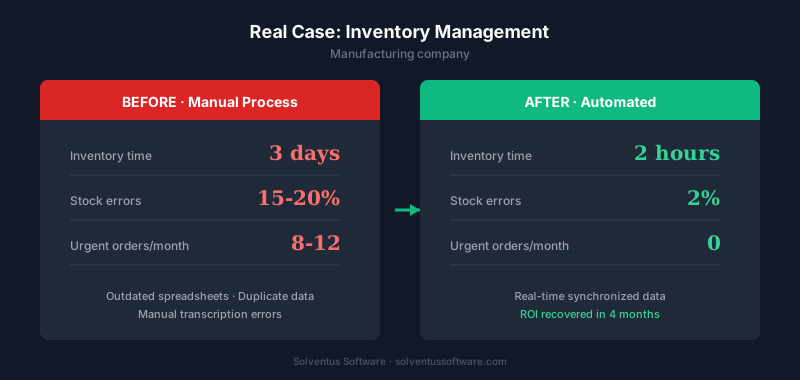
Case 1: Manufacturing Company
Problem: Inventory management using manually updated Excel spreadsheets.
Solution implemented: Automated inventory system with real-time updates connected to production and sales.
Results after 6 months:
- Inventory time: From 3 days to 2 hours
- Stock errors: 87% reduction
- Urgent orders due to material shortage: Eliminated
- ROI: Investment recovered in 4 months
Case 2: Professional Services Firm
Problem: Manual invoicing requiring 3 days per month between generation, sending, and follow-up.
Solution implemented: Complete automation of the billing cycle with bank integration.
Results:
- Billing time: From 3 days to 3 hours
- Average collection: From 45 days to 28 days
- Annual savings: €18,000 (time + reduction in non-payments)
Case 3: Logistics Company
Problem: Manual delivery coordination via WhatsApp and phone calls.
Solution implemented: Route management app with automatic customer notifications.
Results:
- Daily calls: From 50 to 5 (incidents only)
- Customer satisfaction: +40% in surveys
- Failed deliveries: -60%
How to Calculate Your Automation ROI
Before investing in automation, you need to understand where your greatest savings potential lies.
ROI = (Annual Savings − Implementation Cost) ÷ Implementation Cost × 100
In other words: if you save €25,000 per year and implementation cost €10,000, your ROI is 150%.
Step 1: Identify Your Candidate Processes
The best candidates for automation have these characteristics:
| Characteristic | Why It Matters |
|---|---|
| Repetitive | Executes the same way every time |
| Rule-based | Predictable decisions |
| High volume | Many executions |
| Error-prone | Humans make mistakes |
| Time-consuming | Hours of manual work |
Step 2: Quantify the Current Cost
For each process, calculate:
- Weekly hours dedicated by all employees
- Cost per hour (salary + social charges)
- Cost of errors (correction, rework, lost customers)
- Opportunity cost (what could those people do if they weren’t doing this task)
Step 3: Estimate the Savings
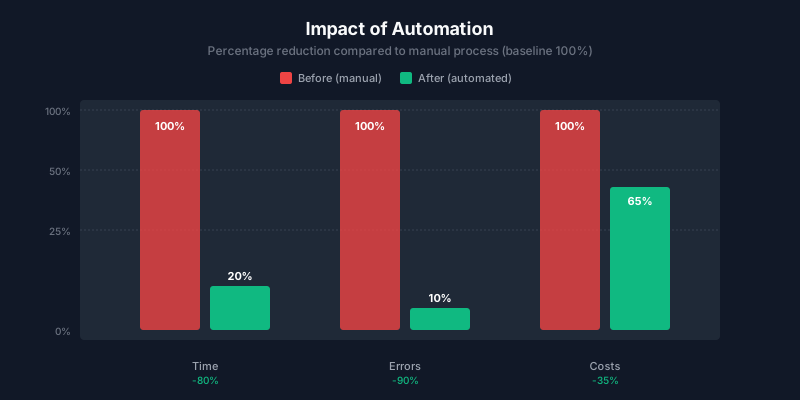
Automation typically reduces:
- Process time: 70-90%
- Errors: 80-95%
- Operating costs: 20-40%
The 5 Processes with the Highest ROI to Automate
Based on our experience with dozens of companies, these are the processes where automation generates the greatest return:
1. Invoice Processing
- Typical savings: €15,000-30,000/year
- Implementation time: 2-4 weeks
- Expected ROI: 300-500%
2. Customer Onboarding
- Typical savings: €10,000-20,000/year
- Additional benefit: Better customer experience
- Expected ROI: 200-400%
3. Inventory Management
- Typical savings: €20,000-50,000/year
- Additional benefit: Zero stockouts
- Expected ROI: 400-800%
4. Reporting and Analysis
- Typical savings: €8,000-15,000/year
- Additional benefit: Real-time decisions
- Expected ROI: 150-300%
5. Customer Communications
- Typical savings: €5,000-12,000/year
- Additional benefit: Consistency and speed
- Expected ROI: 200-350%
Common Mistakes When Automating (and How to Avoid Them)
Mistake 1: Automating Broken Processes
Problem: Automating a bad process just makes it fail faster. Solution: First optimize, then automate.
Mistake 2: Trying to Automate Everything at Once
Problem: Projects too large that never finish. Solution: Start with one high-impact process and expand.
Mistake 3: Not Involving Users
Problem: Systems that nobody uses. Solution: Employees who execute the process must participate in the design.
Mistake 4: Forgetting Maintenance
Problem: Automations that stop working. Solution: Plan support and updates from the start.
AI and Automation: The Next Level
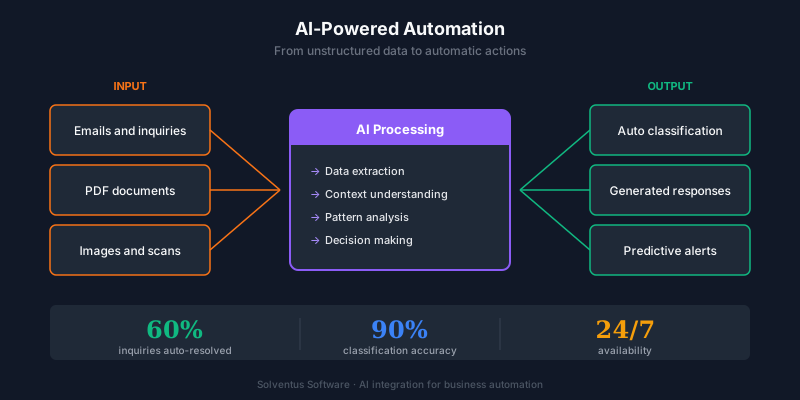
Artificial intelligence is taking automation to another level. We no longer just automate repetitive tasks—we can now:
- Extract data from unstructured documents (emails, PDFs, images)
- Make decisions based on historical patterns
- Predict problems before they occur
- Respond to customers with natural language
Real Example: AI in Customer Service
A company with 500 daily email inquiries implemented:
- Automatic classification by query type
- Automatic responses for frequent queries (60% of total)
- Intelligent prioritization of the rest
Result: The customer service team went from 5 people to 2, with better customer satisfaction.
Action Plan: Your Next Steps
If you’re considering automating processes in your company, here’s a practical plan:
Week 1: Audit
- List all processes that consume more than 2 hours weekly
- Identify the 3 with the greatest automation potential
- Calculate the current cost of each
Week 2: Prioritization
- Evaluate complexity vs. impact
- Select 1 process to start
- Define success metrics (time, errors, cost)
Weeks 3-4: Exploration
- Research existing solutions (not everything requires custom development)
- Consult with experts for viable options
- Request quotes and timelines
Conclusion: The Time to Automate Is Now
Companies that don’t automate are subsidizing their competition. Every hour your employees spend on repetitive tasks is an hour they’re not using to innovate, sell, or better serve your customers.
The question isn’t whether to automate, but what to automate first.
Free Automation Audit
At Solventus, we offer a free 30-minute audit where:
- We analyze your current processes
- We identify your 3 biggest savings opportunities
- We give you an ROI estimate with no obligation
No aggressive selling. Just insights that could save you thousands of euros.
Have questions about process automation? Contact us at [email protected] or through LinkedIn.
 ChatGPT
  Claude
  Perplexity